|
About The Arboretum |
||||||||||||||||||||||||||
|
(Wed Sept 16th 1840) |
|
|||||||||||||||||||||||||
|
Map (1852) |
|
Restoration & Tree Management |
||||||||||||||||||||||||
Derby Arboretum is sometimes incorrectly referred to as "Arboretum Park" by various sources. This is a fairly common error made by "Non Derbeians", Derby people have always referred to it as THE ARBORETUM or "The Arbo". Joseph Strutt named the Arboretum, on Wednesday September 16th, when he handed it over to "The Town", with the following statement: "Having thus prepared this piece of land for the intended purpose, I have given it the name of The ARBORETUM" Derby Arboretum is however listed in the English Heritage Register as "Derby Arboretum and Park". The Arboretum and Rose Hill Recreation Grounds are located within an area enclosed by Normanton Road, Osmaston Road, Reginald Street and Rose Hill Street. The area was shown on maps and land deeds at the time the Arboretum was constructed as "The Liberty of Litchurch" which was bounded by Gallows Balk and Litchurch Balk. Although Litchurch Balk has not been identified on any of the old maps, it can be safely assumed that it formed the boundary at what is now Twyford Street and Loudon Street/Madeley Street junction, and was a continuation of Gallows Balk. In the year 1827 John Claudius Loudon first suggested the idea of planting some public walk according to the natural system, and naming the trees in the same manner which had recently been used at Kensington Gardens. Joseph Strutt also wished to create public walks, and his original intention was to create a complete Botanical Garden, however he was advised that this would be too expensive to maintain. The Worlds First? Arboretum Is Created Joseph Strutt commissioned J. C. Loudon to create a "Pleasure Ground" or "Recreation Ground" "to offer the inhabitants of the town the opportunity of enjoying, with their families, exercise, and recreation in the fresh air, in public walks and grounds devoted to that purpose". Following Loudon's advice, and "being desirous of uniting, as much as possible, information with amusement", he decided not only that these walks "should be laid out in the most advantageous manner", but that "they should comprise a valuable collection of trees and shrubs (from around the world), so arranged and described as to offer the means of instruction to visitors". A certain amount of compromise was reached between Strutt; who wanted a pleasure ground with a collection of trees; and Loudon, who wanted a collection of trees, shrubs and woody plants for the purpose of scientific and educational study, as defined by himself in his publication of, The Arboretum et Fruticetum Brittannicum, in 1838. This compromise resulted in the required collection of trees, but also with provision of two open spaces, devoid of trees, in Joseph Strutt's own words; "Where a band might stand and people might dance &co". When the task had been completed, under the supervision of Loudon and his apprentice, Mr. Rauch, Joseph Strutt named these public walks and grounds, "The Arboretum"
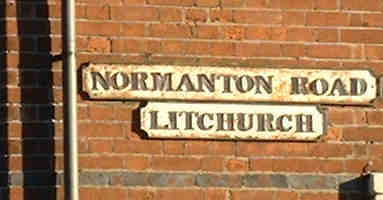
Street nameplates at the junction of Grove Street and Normanton Road The Recreation Ground An additional 6.5 acres of land adjacent to the Arboretum was purchased between 1845 and 1879. This consisted of one large rectangular field flanked by two lime tree avenues, purchased by the town council in 1845, and is now within the area covered by the Arboretum, Reginald Street and Rose Hill Street. A smaller field bounded by the Arboretum and Madeley Street, was purchased by public subscription in 1852, this was intended for use as a children's playground from the outset. A further addition was made during 1879, with the purchase of "Gallows Field", an area adjacent, to Loudon Street, after the landowner lost interest in building a house, which would have been No 1 Madeley Street, and sold the land to the town council. The large playing field was known as Rose Hill and was separated from the Arboretum by a boundary fence with a gate. The Arboretum was approached via the two paths along the lime tree Avenues. These extensions brought the total area of public space to 17.5 acres. An elaborate cast iron bandstand with a polished copper roof was built in the centre of the central field in1899 and the present playground area was used as a football pitch where Derby County played some of their first games. The Rose Hill Recreation Ground, though generally accepted as part of the Arboretum, is actually an entirely separate entity. Unlike the adjoining Arboretum, it is not a Grade II* listed site with all the constraints of English Heritage's guidelines and restrictions. The absence of these restrictions, and the granting of appropriate planning consents, means that a new modern children's playground, games courts, football field and a new community building can be built on the site.
Photographic record of works undertaken The Arboretum had been neglected and vandalised for many years, and local people tended to be suspicious of any proposals to restore it.
England's First Public Park? Joseph Strutt wished to give the people of Derby a free "Pleasure Ground" or place of free public walks where the public may exercise, take in the fresh air, receive instruction (Education) and an area where "A band may stand and people may dance &co". A distinction has to be made between the term "public park" and "public land", research work carried out for this web site has failed to locate details of any landscaped public land, in the true sense of the meaning of Free Public Walks, in England or Wales, either donated or purchased by public subscription, prior to September 1840 when Joseph Strutt gave the Arboretum to Derby. The 1833 select committee on public open spaces resulted in the creation of a number of open spaces within the newly industrialising towns and cities, Strutt had suggested Chester Green could be made into a public park, but this did not happen until 1882. Other spaces were created throughout the United Kingdom, but none could have been described as "a park". Derby Arboretum is certainly England's first. The Arboretum may not however have a claim to being the oldest public park in Britain as Glasgow Green, a stretch of parkland in Glasgow's East End, was first mentioned in 1175 - which would make it the oldest public park in the whole of Europe. In 1814 the land to the south of the River Clyde was designated Europe's first public park. However, it must also be noted that this parkland was not laid out as a public garden, or public walks in the manner described by Loudon, therefore Derby Arboretum may yet be considered as the first of its kind for the whole nation. Humphry Repton's work with 18th-century private parks and pleasure grounds was used as a basis for the design principles in laying out 19th century public parks and gardens. The Garden History Society and Victorian Society's publication lists the following parks, among others, as fine examples of this trend: Derby Arboretum (given to the people of Derby on September 16th 1840, pre-dating any other UK Park ); Philips Park Manchester (1846); Grosvenor Park Chester (1867); Hesketh Park Southport (1868); Stanley Park Liverpool (1870); Abbey Park Leicester (1882); Hanley Park Stoke-on-Trent (1891); Prince's Park Liverpool (1842); Birkenhead Park, (claims to be the first public park in the world, however as it opened in 1847, taking about third place in the ranking); Crystal Palace Park London (1845); People's Park Halifax (1857) and Baxter Park Dundee (1863). It appears that the Rose Hill Recreation Ground extension, purchased by the council in 1845 and separated from the Arboretum by a fence and lockable gate, has always had free public access at all times. If this is the case, this would pre-date Birkenhead by two years, making this the country's first municipally funded public park. Loudon stated in his Encyclopedia of Gardening (1822) "Till lately, Hyde Park, at London, and a spot called The Meadows, near Edinburgh were the only equestrian gardens in Britain; and neither were well arranged". The Derby Arboretum was the first public garden which fulfilled Loudons ideal of a garden of public instruction.
Heritage Lottery Fund Given its importance as a Heritage Site, (Grade II* Listed) being the country's first public park, Derby City Council successfully bid for Heritage Lottery funding of almost five million pounds (4,246,000) to help pay for the Arboretum's refurbishment. Further investments will bring the total amount up to five and a half million pounds .
The New York Connection The design for the Arboretum set an important precedent for public parks in both England and abroad. In 1844 Charles Mason Hovey, editor of the Boston-based Magazine of Horticulture remarked that the Arboretum was by far the best he had seen on his tour of Scotland, England, and France. Why not such an Arboretum in America?, he asked. Influential American
landscape architect, A. J. Downing visited in 1850 and praised the
horticultural excellence and neatness of the grounds. Frederick Law
Olmsted, designer of Central Park, New York (1858-77), arrived in 1859
on his third trip to Europe. (The Central Park commission had sent him
abroad to study the design and administration of parks). In an article
he later wrote on parks for the New American Cyclopedia (1861),
he paid tribute to the great park makers of the 19th century, including
Loudon: In more recent times, the good services of Repton, Loudon,
Paxton, Kemp, our own Downing, and other artists and writers on the
subject (of landscape design) during the past century, merits warm
acknowledgment. (Mclaughlin 1983: 359) A number of English parks visited by Olmstead, notably Derby Arboretum and Birkenhead Park, influenced his design for Central Park, sections of which bear a close resemblance to Derby Arboretum.
Source - Heritage Lottery Fund Urban Parks Programme Stage 2 Submission November 2000 (Landscape Design Associates)
The following information has been drawn from the Heritage Lottery Fund Bid, whilst the details referring to the purchase of land appear to be correct, there are some serious doubts concerning the extent of Loudon's involvement with the Arboretum's creation and Joseph Strutt's original intentions for the eleven acre site. There is good evidence that strongly suggests that the Arboretum was copied from an earlier design. I (author) am now nearing the completion of four years of extensive research, the details of which will be published shortly. Keep an eye on this website for further details Recorded Information Regarding The Purchase Of Land The
deeds referring to Joseph Strutts purchase of the land offer
indications as to how land in the area was being used for farming and
probably market gardening. In 1796 Strutt purchased land from Leacroft,
this land may have been at the north and north-west end of the site, given
that Leacroft owns adjoining property. In 1799 from Thomas Saxelby,
he purchased a close late in 2 closes called Bisses Closes together
with dwelling and buildings and with all hedges, ditches and mounds.
(No ditches or mounds are shown on the plan but the buildings appear to be
roughly on the site of the later East Lodge of the Arboretum, if the
location is estimated correctly). In 1801 he purchased from Wilson
(gardener) a small piece of land, which was bounded on the west and
north by a cottage and lands belonging to Strutt himself, and contained
296 superficial yards or thereabout, including the old ditch
adjoining and another ditch. The cottage appears to be the one which
was incorporated into the Arboretum. In 1822 he purchased from
Galton, Basses Close or Pingle with barn or building together with all
houses etc (this is likely to lie in the middle part of the Arboretum, as
the eastern end, purchased from Saxelby, had also been in Bisses or Basses
Closes). There are hints of landscape features which preceded the Arboretum in the reference to mounds in the 1799 purchase and in the ditches referred to in the 1801 deed. However, the descriptions are insufficient to determine the age or origin of these features. The mounds could have been remains of prehistoric burial mounds, rabbit warrens, spoil heaps, collapsed kilns (for pottery or lime) or possibly remnants of ridge-and-furrow ploughing, or perhaps even natural. The ditch and old ditch may have been part of Medieval or Post-Medieval field boundaries or possibly the old ditch was part of a parish boundary between Litchurch and St. Peters parish, Derby. A map of 1838 shows the latter running along Grove Street. With the records of land purchased from Leacroft of Litchurch Grange there is a reference to Litchurch Balk in a lease of 1769. The word balk or baulk was used to refer to strips of un-ploughed land between blocks of ploughed strips in Medieval open fields (Rackham 1986, 165). A Balk was also usually a raised area of land, with a ditch on either side, and forming a physical boundary between two designated areas (Parish boundaries etc.). Though no mention of Litchurch Balk has been identified on any of the old maps, Recent research by Local Historian and Heritage Feature writer for the Derby Trader, Ron McKeown, and myself has identified the boundary as Gallows Balk, as shown on some earlier maps. The Balk used to run along Grove Street and turned south to follow the line of Normanton Road, The street name plates at the top of Normanton Road offer some evidence as to the existence of such a boundary. The
Arboretum was within the Liberty of Litchurch', whether it
was on the land purchased by Strutt from Leacroft. The same lease also
refers to Litchurch Field, probably one of the Medieval open fields of
Litchurch, and Potters Close and Meadow, as well as lime pits, all on
Leacroft land. Deeds (1845/6) accompanying the Rose Hill extensions mention Upper and Lower Gallows Closes and part of a close formerly called Long Meadow and more recently Grange Field, otherwise Broad Close. The conveyance of Upper Gallows Close, 1846, has a small plan showing trees and ponds along the boundary with the Arboretum, probably the same ponds as are shown on Bromleys plan. A further deed of 1854 also transferred several Gallows Closes to the Arboretum Committee, strongly implying that a gallows or place of execution formerly stood in the vicinity, probably in the Middle Ages. The Rose Hill extensions from the beginning were used as recreational ground. Including
extracts
from the Heritage Lottery Fund Urban Parks Programme Stage 2 Submission November
2000 (Landscape Design Associates)
Joseph Strutt's Vision for Derby Joseph Strutt had long held a vision for his home town of Derby, he saw it as a place where there would be exhibitions of art and science that would be open to the public, where the people would experience the benefits of open spaces where they could breathe fresh air and take part in recreation activities. He had a vision of Derby as a centre for commerce and banking, where all the citizens would benefit from the town's commercial success. Mr. Strutts instructions to Mr. Loudon were as follows:
Loudon, also a renown botanist, architect, author of many books on these subjects and a great social reformer, was responsible for selecting and planting the trees, the following is an extract from his "Derby Arboretum a Catalogue Of Trees planted in it":- Trees must, in most cases, be placed near the road, so as to form foregrounds to the interior of the park; and between the road and the boundary, they will be required for the purpose of disguising that boundary, or forming foregrounds to the scenery beyond . . . In the interior of the park there should be few or no closely planted masses; for the effect of these is to diminish the apparent space, and to curtain the appearance of extent from every point of view . . . Trees should be disposed so as to give the greatest depth of view across the park, and, at the same time, never to show the road or the boundary in the distance (Loudon 1835: 652) He also stated in his Arboretum, a Catalogue of Trees and Shrubs, that: "Trees appearing as the shaft of a column without a base or capital" was a "monstrous and unnatural appearance". He directed that all the trees were to be "planted on little hills, the width of the base being three times the height of the hill, so that the junction of the main roots with the base of the trunk will appear above the ground". Work commenced in July 1839 under the supervision of Loudon's assistant, Mr. Rauch, as soon as a crop of hay had been harvested. Mounds were moulded into suitable shapes, connected by concave sides and lateral ridges with the surrounding surface. Trees and shrubs were planted according to Loudon's instructions, Mr. Rauch supervised all of the work undertaken at the Arboretum until its completion in September 1840. The lodges and pavilions were designed by Edward Buckton Lamb, a London based Architect who had a long association with J. C. Loudon, both acting as his draughtsman, translating some of his building designs, and providing his own designs, as was probably the case in this instance. The north, or main, lodge was built in the Elizabethan style; the east lodge in the Tudor style. The pavilions were built in the style of James I and the gates to the north, or principal, lodge were cast from E. B. Lambs designs by Messrs. Marshall, Barber, and Co. of Derby, the building work carried out by a local builder, Mr. Thompson and the landscaping work contracted to Mr. Tomlinson of Derby The trees and shrubs were supplied chiefly by Messrs. Whitley and Osborn, but partly also by Mr. Masters of Canterbury; and the miscellaneous collection of roses was furnished by Mr. Rivers of Sawbridgeworth; the mistletoe was supplied by Mr. Godsall of Hereford; and some species, which could not be procured in the nurseries, were obtained from the Horticultural Societys Garden. All the trees and shrubs were to be
labelled, explaining the species, expected growth height, type of fruits
(where applicable) the origin and the date of planting by means of brick
tally holders secured in place by an iron frame with a tiled top. These
have long since disappeared.
|
||||||||||||||||||||||||||
|
|
|
|||||||||||||||||||||||||
|
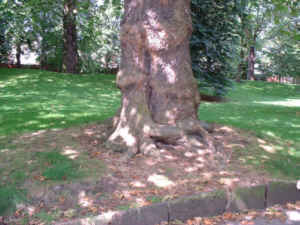
The trees planted on the slope side of the mounds caused the roots to become exposed as Loudon intended. |
Each tree was labelled to show the type, maximum height (expected growth), date of planting, and origin. This is an example of a later surviving date Tally
|
|||||||||||||||||||||||||
|
The Arboretum Plan Four straight paths (Broad Walks) converging at a central point (originally to have been a statue within a circular arrangement of stone seating) were laid out with the east to west paths terminating at pavilions, one by Arboretum Square entrance to the east and another by Harriet Street entrance to the west. The main path would terminate at two focal points, Grove Street Lodge to the north and the Florentine Boar to the south-east. Serpentine pathways would encircle the whole area with the mounds and shrubs obscuring the view of the opposite pathways, helping to give the illusion that the park is much larger than it actually is. Heavy pollution, caused by local industry, meant that many trees and shrubs in the original collection were unable to survive and were destroyed. they were replaced by London Plane Trees (able to withstand the pollution) and Limes. |
||||||||||||||||||||||||||
|
A "Free" Public Park? |
||||||||||||||||||||||||||
Joseph Strutt had given a great deal of thought as to funding the upkeep of the Arboretum and he decided that it would not be in the interests of the park to provide an endowment for its upkeep. He believed that it should be maintained by the people who own it, i.e. the public. To this end there was to be a small admission charge, threepence for children under 12 and sixpence for everyone else, for five days of the week. It has been suggested that as there was an entrance fee for five days of the week, the park could not be considered a "PUBLIC" park. The mill owners who sat on the committee that controlled the park were alleged to have overruled Loudon's intention to make the park available to all classes by imposing restrictive admission charges. However according to Loudon's "Derby Arboretum, a catalogue of trees and shrubs in it" charges of sixpence and threepence (about 21/2 pence and 1 1/4 Pence in Decimal Currency, respectively) were made from the outset. One must consider the fact that the working classes; the Foundry-men, the Mill-hands and the Railway workers were working ten hours per day and only had Sunday off work, hence the need to close the park for a few hours on Sunday to ensure they had time to attend church. It may seem odd that Wednesdays were chosen as the second FREE day for the Arboretum, however there had been a lot of pressure from the "Half Day Holiday Association" at the time, to close all the town's shops for half a day per week (excluding Sundays, when all work-places were closed). So Derby had its half day closing on a Wednesday, a day when all the shop workers and trades people would be allowed to enter the Arboretum, free of charge. The Arboretum, on all days, would open no later than 6 am and close no later than 9 pm, it should be closed on Sunday between 10 am and 1 pm to allow the local inhabitants time to attend church services. The outcome of the entrance charges was that the upkeep of the park was paid for by those who could afford it, while those who had neither the money or the time to visit the park during their long working hours, were given free access on their days off work. The number of days on which admission was free increased over the years with the abolition of entrance fees by November 1882 when the town council took over the running of the park. An interesting footnote to the subject of cost and affordability for the Victorian working classes, is that 4.5 million working class people visited the Great Exhibition of 1851 (at the Crystal Palace in Hyde Park, London) at a cost of one shilling per person, plus of course the train fare to get there. |
||||||||||||||||||||||||||
|
Managing the Arboretum |
||||||||||||||||||||||||||
|
Loudon had laid down some strict rules as to the management and upkeep of the Arboretum:
|
||||||||||||||||||||||||||
"It forms no part of the design of this Arboretum to exhibit large trees, more especially of the common kinds; and whenever any one of these, or, indeed, any tree whatever in the Arboretum, reaches a height of 40 or 50 feet, it should be removed. That height is quite sufficient for producing shade, and showing the form and character of the tree, and its flowers and fruit; and nothing more is required, or can be admitted in an arboretum on so limited a piece of ground. If this part of the management laid down be neglected, the rapid-growing large trees will over top the slow growing smaller ones and the shrubs and ultimately destroy all the finer kinds". (J. C. Loudon 1840). And to the day to day management: "What I (J.C. Loudon) consider to be the highest order consists in the following particulars : The walks should be at all times perfectly dry, smooth, firm, free from weeds, worm-casts, or other extraneous matters, and with the gravel of a good colour: the turf equal in thickness, free from all broad-leaved plants except clover, closely mown, smooth, firm, dry, and everywhere without worm-casts, mole-hills, ant-hills, dead leaves of trees, bits of paper, or any other extraneous matter which may be blown about, or left on it by visitors : the flower-garden perfectly free from weeds, and every bed filled with plants in a healthy state, and the beds well covered with flowers : the vases filled with flowers, in the manner above described, from the middle of May till October; the flowers being in pots, and either of green-house or hardy kinds, named on a card tied to the narrow part of the vase, and changed not less than than once a week; the same species not being more than twice introduced during the same season. All the trees and shrubs to be kept without dead wood, perfectly free from caterpillars, aphides, curled leaves, honeydew, leaves which have been killed, or branches which have been broken accidentally, and from flowers or fruits which have decayed and not dropped. The climbers or twiners to be kept tied up; the spaces round the trees free from weeds; the seats quite clean; the name tallies in complete repair; the boundary fence, lodges, and gates, in complete repair; and the labourers, and their wives and families who attend on persons who enter the garden or the lodges, clean and neatly dressed. This
may be considered as the criterion of good regular management; but there
are certain points to which I wish to direct the special attention of
the curator and of the public, and especially of the public press. The first point respects pruning. On no account whatever is the knife to he applied to any of the trees or shrubs, except in the following cases : for the purpose of cutting out dead wood, branches broken by the wind or by any accident, dead or decayed flowers or fruit, or for removing the suckers or side shoots which come out below the grafts of such species or varieties as have been budded or grafted. No decaying leaves whatever, and no ripe fruit, are on any account to be cut off; but leaves which wither or are killed in the course of the summer may be removed as soon as they are perceived. Pruning is prohibited, in order that every plant may show its natural shape and habit of growth ; whether by growing erect, spreading horizontally, or throwing stickers up, or rambling shoots out, on every side. The suckers are not even to be thinned out, but every plant is to be allowed as perfect a freedom of growth as if it were in its native habitat. The only exception is, such climbing, twining, or trailing plants as are to be trained up to the rods or props prepared for them, instead of allowing them to trail on the ground; but this is to be done without cutting off or shortening any of their shoots". J. C. Loudon September 1840 Unfortunately Loudon's plan was lost due to unforeseen circumstances - as the trees were killed off by pollution. From
"The Arboretum, a Catalogue of Trees and Shrubs" J. C. Loudon
1840. Courtesy of Derby Local Studies Library.
Unfortunately Loudon's planned Arboretum was destroyed by heavy pollution between 1860 and 1881, when 90% of the original trees, shrubs and plants were killed. Joseph Strutt's intention of providing a collection of trees and shrubs "for the entertainment and Instruction of the local population" was lost. In 1881, the Parks Superintendent, Mr. T Husbands, instigated a programme of tree plantation to cover for the lost collection and selected hardy London Plane and Lime trees, which could resist the pollution from the surrounding housing and factory complexes, though failing to fulfill the intentions of Loudon and Strutt, at least gave some tree cover. The plans approved by English Heritage, to reinstate as much of Loudon and Strutt's original collection of trees and shrubs as possible, commenced with the removal of 109 of the Arboretum's 600 trees. The trees selected for removal were mainly over mature, dying, dangerous, or trees, though healthy, are causing serious problems for other more important trees. The plan has resulted in one sixth of the current trees being removed, to be replaced by 156 trees, at the end of 2003, which will largely reflect the original collection, and help to restore Loudon's original concept. |
||||||||||||||||||||||||||
| See "A Gift To the People" Arboretum Home Page |
Copyright Christopher Harris 2002-2006 |
|||||||||||||||||||||||||