|
The Crystal Palace |
|||
Last updated September 14, 2025 |
|||
What would the Crystal Palace look like if it were here today? |
|
Free JavaScripts provided More Structures and Ornamentation:
Crystal Palace |
|
|
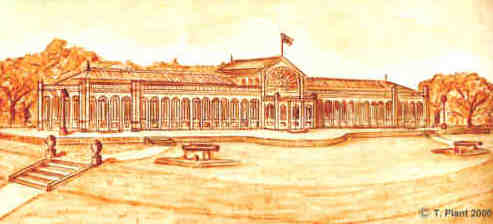
Drawing by local artist, Trevor Plant, of a copy of a print used in the original bid to build a replica of the Crystal Palace at Derby Arboretum's Rose Hill Recreation Ground. |
|||
|
|
|||
|
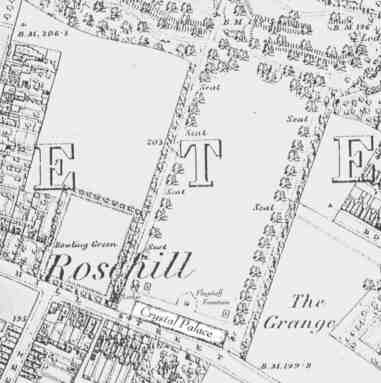
1860 Map showing the location of the Crystal Palace (located along the Rose Hill boundary wall). Courtesy of Derby Local Studies Library. |
|||
| See comment from Derby Mercury, November 8th 1882 | |||
| One theory
behind the Arboretum's Crystal Palace was that it was a copy of the
Great Exhibition building designed by Joseph Paxton and built by Charles
Fox - this would have nicely complimented the history of the original
Crystal Palace, and would have been a suitable local monument to
Paxton's work.
However other local historians, with an interest in the Arboretum, have evidence to the contrary. Ron McKeown, who writes the Derby Trader's Heritage Feature page, tells me that according to Richard Wood, a trustee of the Derby Heritage Trust, accredits the design to Henry Duesbury, who also designed Arboretum Square entrance and Orangery. The work may very well have been conducted by Charles Fox, the builder of the Great Exhibition hall of 1851. The following is an account of the Crystal Palace of 1851 Joseph Paxton, the Duke of Devonshire's gardener at Chatsworth, first thought of the idea of a large glass house when he noticed the apparently fragile leaves of a giant lily pad could support the weight of an adult person. He created the green houses at Chatsworth using a cast iron framework of small repeating patterns, based upon the ribs and stems of a lily pad, to support a large area of glass. When a building design was being sought to house the Great Exhibition of 1851 Paxton conceived the idea of an enormous glass house whilst waiting at the new Midland Railway Station on Midland Road, Derby, where he "doodled" an outline on a sheet of Midland Station blotting paper. This has since become known as the "Derby Doodle". When it came to building this incredible structure Paxton enlisted the engineering skills of a Derby man, Charles Fox, a Civil Engineer who had helped Robert Stevenson with the building of the London and Birmingham Railway. The name "Crystal Palace" was meant as a derogatory description of the exhibition building "It looks like a Crystal Palace" commented a reporter at the time. The name stuck but has become something to be proud of rather than mocked.
|
|||
|
The Crystal Palace Public House |
 |
The Arboretum's Building was demolished in the 1890s but is remembered in the name of a Public House, "The Crystal Palace" on the corner of Rose Hill Street and Madeley Street (left). | |
|
Derby Mercury (1882) Comment relating to the upkeep of the Arboretum. "Our neighbours, Nottingham, have long set us an example in this respect. Their Arboretum always free to the public, has been kept up in a manner which has become the envy of Derby visitors. Brilliant flower beds form the central attraction in well kept grounds to which the public retort with delight! Whilst Derby Arboretum has, however never been noted - of late years - for anything but its unadorned barrenness and its barn like monstrosity, satirically named "The Crystal Palace". Derby Mercury, November 8th 1882 Derby Local Studies Library News-cuttings. It must be noted that at the time this comment was written many of the original trees and shrubs had perished due to the heavy pollution caused by local industry. The situation would have been much improved a few years later following the planting of many more trees and shrubs. It also must be noted that even though the article did mention the Crystal Palace being in the Arboretum, it was actually on the Recreation Ground, which has always been independent of the Arboretum. |
|||
|
Copyright Christopher Harris 2002-2006 |
|||
|
Crystal Palace Restored? |
|||
|
|
|||
|
This is a view of Rose Hill Street with the Crystal Palace shows how it might have looked if it was still standing |
|||