Important Statues (missing, destroyed or lost)
Asclepios and Hygeia
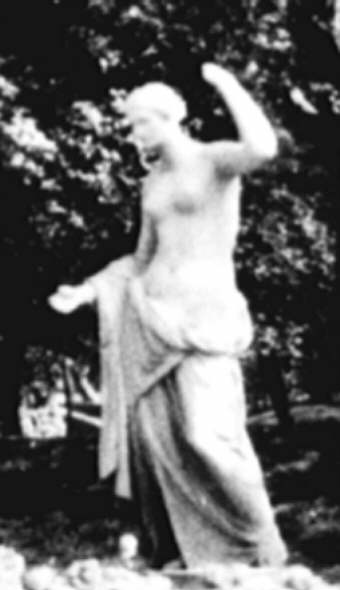
The Greek God of Medicine Asclepios renamed Aesculapius by the Romans, and his daughter, Hygeia, were placed in the Arboretum during 1840. These statues were certainly representative of the healing properties of the trees and shrubs within the Arboretum, indeed Asclepios represents the Olive, Cypress and Pine trees.
The statue was made from earthenware by by William John Coffee in 1810. It was possibly a Maquette or model for the larger version which stood on top of the Derbyshire General Infirmary dome between 1810 and 1890. This smaller version was moved from Joseph Strutt's garden on Thorntree Lane,1840.
Asclepios also known as Aesculapius
Other Important Statues
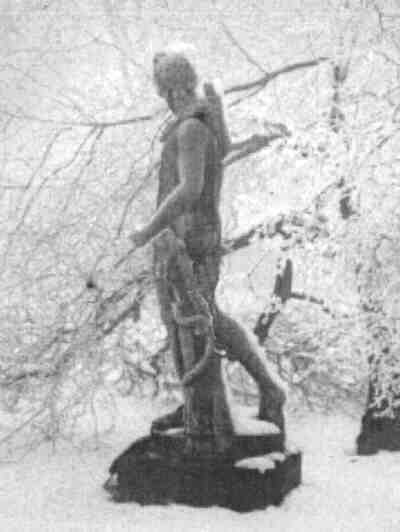

Photo courtesy of Derby Evening Telegraph
by The JavaScript Source
Missing Statue of Asclepios (By William John Coffee)
renamed Aesculapius by the Romans
Asclepios' staff is an International symbol of medicine and healing.
Asclepios' symbol was the serpent,
however he also related to the olive, cypress, and pine trees.
Missing Statue, possibly Hygeia Daughter of Asclepios (By William John Coffee)
Photo courtesy of Derby Evening Telegraph
Note: The two statues relating to health were probably a representation of the near-by Derbyshire Infirmary, which was designed by William Strutt.
The hospital was hailed as the best in he Europe and brought visitors from around the world to see the innovative design and the new air conditioning system, which was the first ever used in a hospital, and was invented by William Strutt.
William, George and Joseph Strutt contributed towards the 17,000 cost of building the Infirmary.
These statues, moved from Joseph's garden, would be a clear acknowledgement of the Strutts' involvement with the Infirmary.
Hygeia, one of the daughters of Asclepios (Asclepius) and granddaughter of Apollo, took an important role in the cult of Asclepios as a giver of health, often identified with health and sometimes also called The Health. The Arboretum's statue probably represented the sisters at the nearby Infirmary. The Sisters took part in the Grand Opening Parade under the banner of "The United Sisters of the Sick".
Three statues, created by William John Coffee were placed in the Arboretum. These statues served very specific purposes. The main purpose was straight forward education, an ideal held dearly by both Strutt and Loudon. The Florentine Boar was at that time regarded as an important work of art, it is now regarded as one of the world's major works of Renaissance art, and has a significant international appeal.
Unfortunately Coffee's version of the Florentine Boar was not a particularly good reproduction, being based on artist's impressions of the early 19th century, and it had become eroded and damaged over the 120 or so years since its creation. It would have been better if it had been replaced by a bronze copy some time ago. Now copies are readily available from the original foundry in Italy, the City Council does not have any excuse as to availability and cost of such a replacement.
Other Statues
(The central and most important statue)
If the historical integrity of the Arboretum is to be restored, all of these original statues should be returned.
Though not an original Arboretum Statue, Henry Royce was placed here at the request of Rolls Royce's Directors. This statue is probably better being displayed at the company's Headquarters.