|
The Rose Hill - Victorian Bandstand (See also the Art Deco Bandstand) |
|
|
We want a New Band Stand
More Structures and Ornamentation: The Band Stands The Victorian Bandstand was destroyed during a Luftwaffe bombing raid in January 1941. Source - Derby Evening Telegraph. by The JavaScript Source
|
|
|
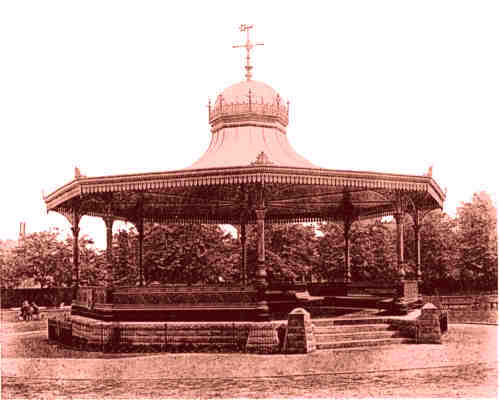
The Victorian Bandstand was located at the Rosehill Recreation Ground, in the centre of what is now a football pitch. See Map Photo dated 1899, this is the only example in existence. The original was in a very poor state and needed considerable digital cleaning before it could be used. It is reproduced here courtesy of Derby Parks Department, with thanks to Tony Griffin. |
|
|
|
|
|
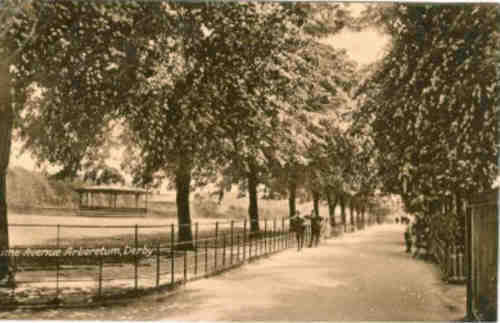
Post Card circa 1900, showing the recreation Ground and Victorian Bandstand Reproduced courtesy of Tony Griffin's collection |
|
|
Judging by the growth of the Lime trees, this photo was probably taken circa 1900, the playing field is clearly fenced off from the avenue and what appears to be a corrugated iron structure (shed or fence) is visible on the immediate right. |
|
| This
very fine example of a Victorian
Bandstand was opened on July 12th 1899 and was located in an area known
as Rose Hill (purchased by the town council in 1845).
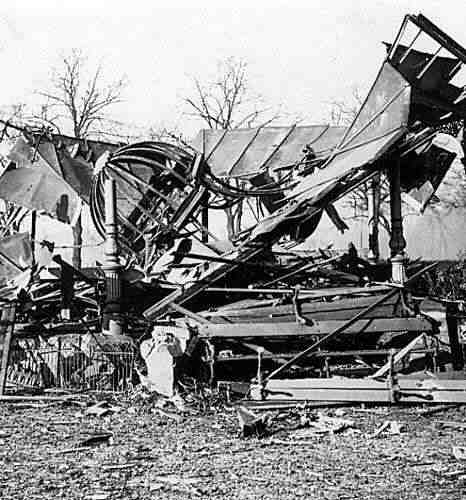
Thousands of people used to travel from all over the Midlands to listen to the many Brass and Silver Bands that would perform here. There are hundreds of Derbeians alive today who remember the Victorian Bandstand, many of whom would have played games, sheltered from the rain or listened to band music as children, right up until its destruction during a Luftwaffe air raid during January 1941, see photo below. |
|
|
The framework for the dome is clearly visible within the twisted wreckage in the photo below. |
|
|
|
|
|
Photograph courtesy of The Derby Evening Telegraph
|
|
|
The mangled wreckage of the bombed Victorian Bandstand |
|
| Back to top of page | |
|
Destruction of the Victorian Bandstand and Florentine Boar Eye Witness Reports on the 1941 Air Raid According to eye witness reports, the Dornier bomber flew in from the Normanton Road side of the Arboretum, it would appear that the first in a "stick" of five bombs dropped, hit houses on Rose Hill Street, the second partially demolished a house in Madeley Street (No. 13 - bad luck there!). The third hit the Victorian Bandstand and a fifth hit Reginald Street at the junction of Osmaston Road, creating a huge crater and blowing out all the windows in the school. The fourth bomb had landed at the Reginald Street Lodge but failed to explode, this was later dealt with by the UXB bomb disposal unit. Shrapnel, possibly a piece of the Bandstand, hit the Florentine Boar and knocked its head off. A large amount of shrapnel has since been found embedded in trees surrounding the boar pedestal and the Heart of the Park building. The evidence appears to support this theory, if a straight line is drawn across an Ordnance Survey Map, all the targets align perfectly and the timing also matches the event.
|
|
|
A late neighbour of mine once told me of his personal memory of the day the Bandstand was bombed as he was returning home on leave from the Army and took a short cut through the Arboretum, via the Reginald Street entrance when the bombs fell. "Bombs were dropping all around me when the bandstand blew up, its amazing I wasn't hurt, fancy flying all the way from Germany just to blow up our bandstand!". According to my Father (13 at the time) a bomb had exploded in the middle of the road at the junction of Osmaston Road and Reginald Street, leaving a huge crater and blowing out all of the windows at the front of Reginald Street School. The nearby Co-op shop also received some heavy structural damage. My father was sent home when he arrived at the school the following morning because the school was declared unsafe - all the kids were delighted because school was out! Reports in the Derby Evening Telegraph's "Bygones" issue (June 24th 2003) give more details: according to a Telegraph reader, Mr. Ken Tucker of Kniveton, the date of the air raid was January 15th 1941, I will accept this as the most likely date. Another reader, Mr. Brian Summers of Darley Abbey tells of his experience during the raid, when he was hiding under a table with his mother at their home in Cummings Street, he goes on to say that Depot Street was also hit during the raid. C. Harris (Researched and compiled by Christopher Harris) (The worst WW II bombing raid on Derby took place during the late hours of 15th & early hours of 16th of January 1941) |
|