|
The Florentine Boar |
|
|
|
|
|
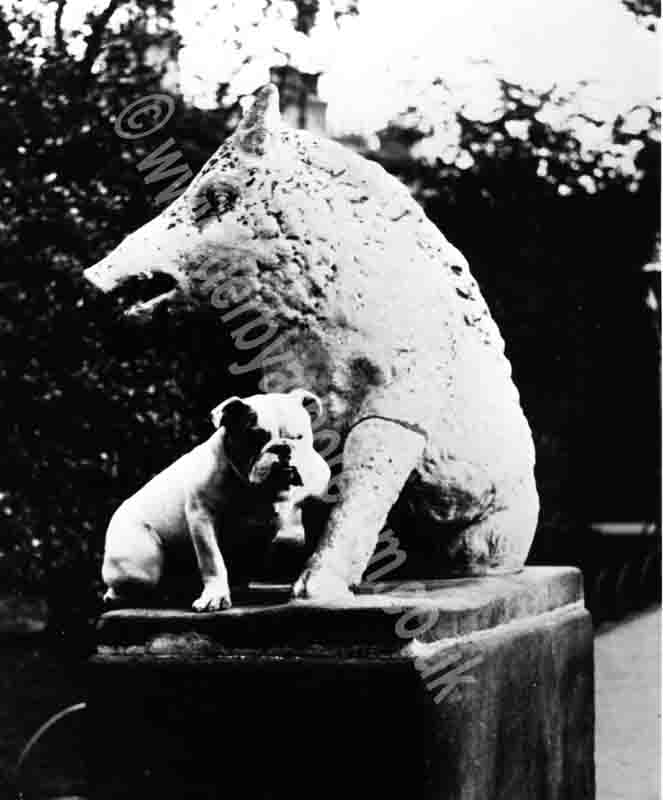
This charming photo was taken circa 1920-29, mentioned in various reports, as yet not published. The bulldog is reminiscent of the Churchill Insurance bulldog. This copy of the original is from Derek Palmer's private collection. |
|
|
|
|
|
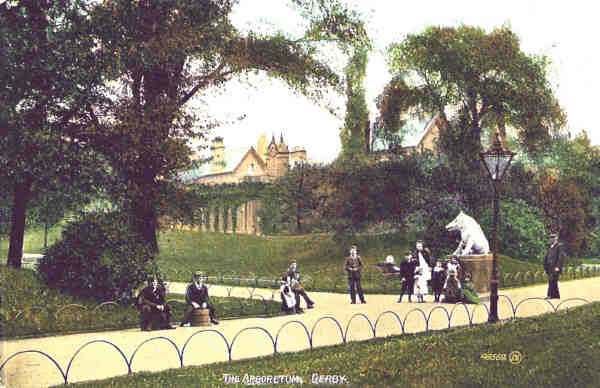
Above: The original boar at the Arboretum circa 1910 |
|
|
Arboretum
More Structures and Ornamentation The Florentine Boar The Original
Free JavaScripts provided |
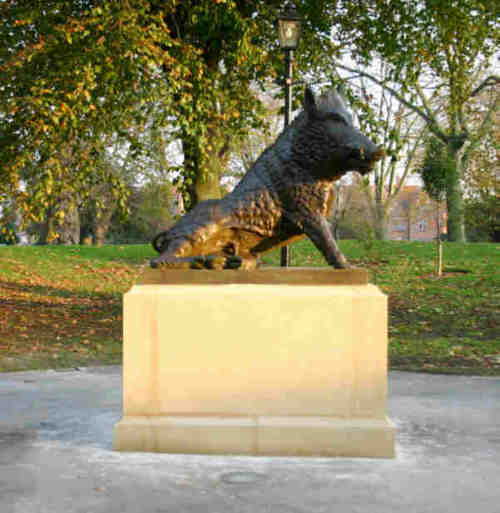
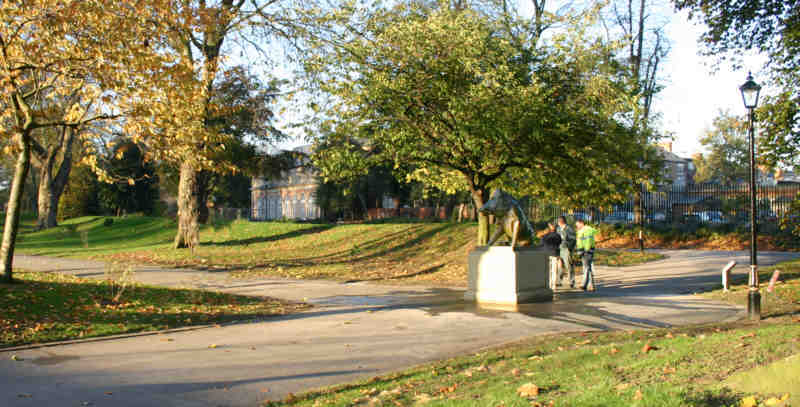
destroyed in 1941 has now been replaced by a new Florentine Boar, (below) |
|
|
|
|
Above: The new Florentine Boar Statue, installed November 18th 2005
|
|
| This sculpture is the most
significant of all
the Arboretum's sculptures, frequently described in the local press as
"One of Derby's best loved works of art" and is fondly
remembered by thousands of Derbeians who have been eagerly awaiting its promised
return.
The statue was a hollow earthenware copy of an original bronze boar fountain, (Cinghiale) which sits on the edge of the Marketo Nuovo (New Market) in Florence. Joseph Strutt, a patron of the arts with a particular interest in Renaissance Art, opened up his own house to show his collection of Renaissance paintings and sculpture - long before Derby had an art gallery and museum. He had commissioned W. J. Coffee to make the boar statue, based upon drawings of the original, for his garden at the current Arboretum site in 1806, where it remained after the Arboretum was completed. The statue was previously believed to have been moved from Strutt's house in St Peter's Street, however Loudon's plan clearly indicates that it was already in place and partly surrounded by some mature trees at the time he laid out the Arboretum. Derby was a pioneer in a trend that has spanned the last 163 (+) years, as there are now hundreds of copies of this statue around the world, with almost every major city in the western world having a copy. Derby's copy of the Florentine Boar was almost certainly the earliest example to be placed in a public garden. Deeply rooted in our Heritage and culture The Boar Statue has become very much a part of the Arboretum's cultural history, heritage and folklore. According to old Derby folklore (probably a bit of fun to entertain the children), it was said that when the Midland Railway Bull sounded, the Boar would leave its plinth and go for a drink at the fountain. |
|
|
|
|
Nannies used to warn their young charges that if they misbehaved in the Arboretum the Boar would get them. Children would often give the Boar a wide berth as they crept by very quietly so as not to disturb him. |
|
 |
|
|
The old Boar was admired and enjoyed by generations of Derby families. It was often, and will again be the centre of attention for family groups visiting the Arboretum. It is also probably Derby's most photographed statue. It was said that there can be no Arboretum without the Florentine Boar, its return has already been welcomed by thousands of Derby's citizens. |
|
|
|
|
|
|
|
|
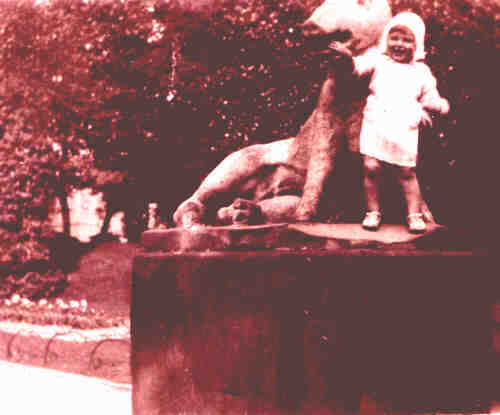
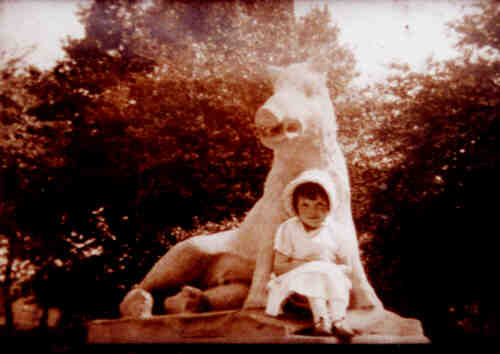
The two photos above show the Boar in 1926 (Top) and 1934 (below) offer evidence of a clean-up and restoration which took place between the two dates. Photographs courtesy of Derek Palmer |
|
|
|
|
|
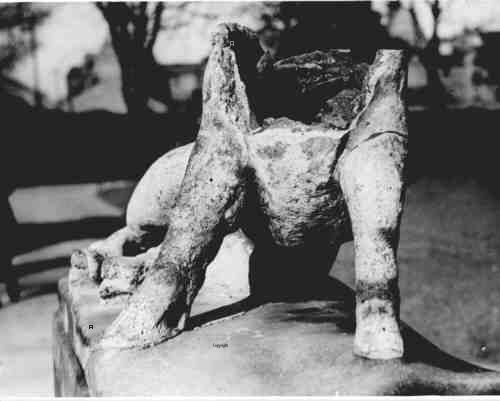
The headless remains of the Florentine Boar, following the German air raid of January 15th 1941 This photo is part of Derby Parks Collection, and was lost to the world. until recently returned to and published by the Derby Evening Telegraph in Bygones courtesy of Christopher Harris. Reproduced here by kind permission of the Parks Dept. |
|
|
German Bombing Raid of 1941?
Bert Broke The Boar? |
The Headless Boar, after the incident that caused the damage. There are a few theories and claims as to how the Boar statue met its demise. The "official" version tells us that it happened when a German bomb destroyed the Bandstand during January 1941, a piece of the Bandstand hit the Boar, knocking off its head as shown in the photo above. This had been verified by a reliable eye witness, who walked through the Arboretum during the raid, on returning home on leave. The photo was actually taken the day after the air raid. However according to The Derby Evening Telegraph's Bygones edition of January 2002, a group of boys climbing onto the statue were to blame. The culprits themselves owned up to the misdemenour in the special about the restoration of the Arboretum. William Whitehurst, (Bert), the youngest of the boys tried to lift himself onto the statue by climbing onto its head, it was then that the head literally came off in his hands. Both explanations sound plausible, and the 'boys' insist that they were responsible, however the case of who broke the boar may never be closed. The remains of the Boar were removed and pieces of it have turned up in unusual places, (the head apparently turned up at Royce's Allotments) but appear to have vanished again without trace. The plinth was itself removed after it was severely damaged following a series of attacks by vandals using stolen cars. Some evidence of a cement-like material is visible around the edges of the hollow, (photo below) this may be evidence of past repair work, possibly the re-attachment of the head when the Boar was restored in 1934 with money raised by public subscription. Note also that the missing left hind leg had been replaced by 1941, compare with top photo and 1890 news article.
|
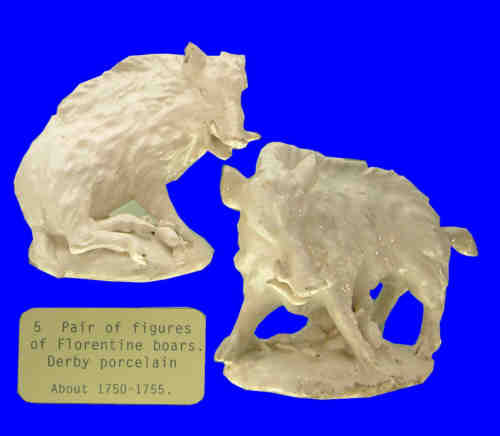
Right: A pair of Derby Porcelain Florentine Boars made around 1750 - 1755. Evidence that the Florentine Boar was a popular figure long before the Arboretum had a copy. Could these figures have influenced Joseph Strutt to commission W. J. Coffee, A Derby porcelain modeller, to make a full size copy of the statue for his garden?
|
|
|
Photograph C. Harris 2004 Courtesy of Derby Museum China display section |
|
| Replacement
The cost of the replacement of the Florentine Boar was included in the original bid. The source of the replacement statue is now to be decided by the council. Copies of the statue are available from the The Ferdinando Marinelli Artistic Foundry, which has already produced hundreds of such copies. |
Restoration of the Florentine Boar See the new Boar Statue Here The Boar was replaced by November 2005, this news has been widely welcomed by the majority of Derby's citizens. Following three campaigns involving a petition signed by over 2000 local people, the Derby Evening Telegraph's backing with several articles and dozens of published readers' letters, and a supporting campaign by local historian and webmaster for Derby Arboretum, Chris Harris. Peter Fitzmaurice organised the petition, with the assistance of his friends and neighbours. He colleted over 2000 signatures in support of the boar's return. This website has consistently supported the return of the statue since its launch in 2002. E-mails have been sent to councillors and council officers, reminding them of the importance of the statue. This website, based on historical information, recommended a bronze replacement replica of the original Florentine Boar. This copy of the original bronze would fulfill Strutt and Loudon's wishes by the fact that it is a copy of the same statue copied by W. J. Coffee. This replacement will be more weather and vandal resistant than a ceramic statue. The latest news on this subject is that the bronze copy is now installed and was officially unveiled on Monday 21 November 2005 More details HERE |
The Florentine Boar - Worldwide The Renaissance Period represented a time of re-discovery of the Greco-Roman period, and a return to realism in art and many such statues were re-produced by famous artists of the period. Pietro Tacca had developed some revolutionary casting techniques during the late 16th century (c1580), which he used to make a bronze cast from the marble boar in the Uffizi Gallery (c1610-20). This was to become known as the Florentine Boar. Five full size (Bronze) copies of the original Florentine Boar were made during the 1960s for several parks in Canada, America and Australia, this trend continues to this day. The Florentine Boar is available as stone, bronze, even a fiberglass moulding, from hundreds of suppliers around the world. Thousands are now displayed publicly around the world, Derby Arboretum was almost certainly a true pioneer of this trend. Other ancient representations of wild boar may be found in the ruins of ancient Roman cities (Worldwide), Greek Islands, the Far East, India. Pakistan, and the Middle East, where the animals are considered as a ferocious challenge to hunters.
|
|
|
Extract from the Derbyshire Advertiser, June 12th 1890 The Boar was also, unkindly and incorrectly, often referred to as "the Pig" by local people. The following is a rather irreverent, humorous but interesting extract from the Derbyshire Advertiser, June 12th 1890: To young Derby this atrocity is known as "th' pig". In the words of a recent writer "He is a decidedly dilapidated looking pig. His attitude viewed from Rose-hill way, is that of a confirmed inebriate. He is cracked, the disintegrating forces of wet and frost having commenced their work. The appearance of the eyes is calculated to deepen your suspicions of his sanity and sobriety. He is recumbent testimony to the surgical skill of the veterinary, for three of his legs have been amputated and stuck on again with cement - one of them in two places. Later some scamp with a liking for 'cold trotters' carried a foot right away. His tail - I blush to report - is missing and has been substituted with by a short brown pillar of the aforesaid cement. He has also been adorned with nameless indignities by the young men of the period. Finally his pedestal is a long way from the square and abominably out of the perpendicular". I think that "th Pig" has earned his retirement from the public service. BA 712 The Arboretum, News cuttings, Derbyshire Advertiser, June 12th 1890 - Courtesy of Derby Local Studies Library. (signed "A Derbeian"). The article covers the 50th anniversary of the opening of the Arboretum in detail. Note: this is a very fragile news cutting in rather poor condition. An unidentified magazine cutting with barely readable print is to be found in the news cuttings folder along with the previous report. From what is decipherable, the article describes the writer's delight at finding the original sculptor's (W. J. Coffee) model of the Florentine Boar. The description of the main work includes information which suggests that the first attempt cracked in the kiln, requiring a second cast to be made from the mould. This comment however appears to be confused with the casting of a ten foot tall Asclepius (Asculapius) Coffee made for the Derbyshire Infirmary in 1810. William John Coffee, (1774 - 1846), worked for some time as a modeller for Duesbury at the china factory. He was an oil painter and internationally renown sculptor, who worked in porcelain, plaster, and terra cotta. He emigrated from England to New York City in 1816, where he became famous as a sculptor for American historical figures such as Thomas Jefferson. Reference from the directory of Derby Artists: Coffee, William John - 1774 - 1846. Modeller for Crown Derby, emigrated to New York 1816. Created a copy of the Florentine Boar for Joseph Strutt 1806 and a statue of Asclepius for William Strutt's Derbyshire Infirmary - 1810. A life size bust of Erasmus Darwin on display at Derby Museum on the Strand, is a fine example of William John Coffee's modelling skills. He also produced a number of terracotta statues of Greek figures representing medicine and healing (now missing or lost) for Joseph Strutt's garden, which were transferred to the Arboretum in 1840 . Return to top of page Home Page
|
|